
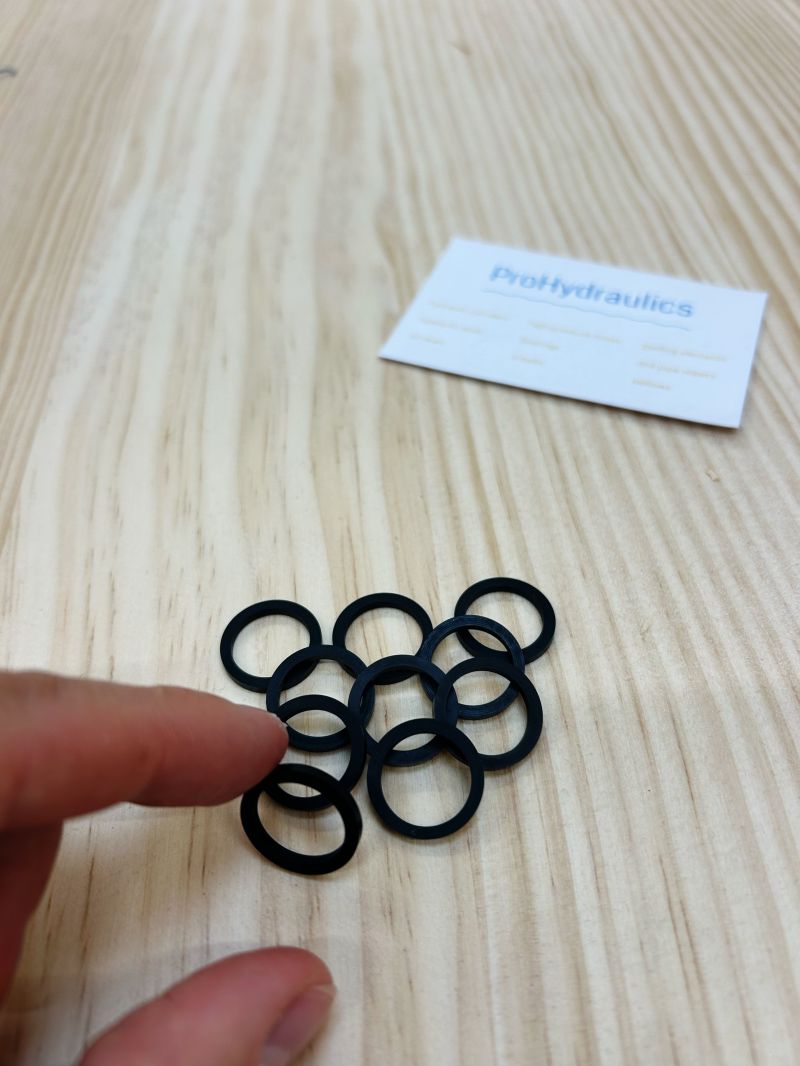
In heavy industry, sealing elements are one of the most underestimated items in procurement. Until the equipment stops.
An O-ring costs less than one euro. But the wrong choice of material, size or hardness leads to leakage — and a leak in the hydraulic system of a metallurgical press or rolling mill means an unplanned shutdown. The cost of downtime in heavy industry is thousands of euros per hour.
Three Parameters That Determine Everything
Material
The wrong material is the most common cause of premature seal failure.
NBR is suitable for mineral oils and standard hydraulic fluids at temperatures up to +100°C. FKM is used where NBR degrades — aggressive fluids, temperatures up to +200°C, oil & gas and metallurgical applications. HNBR provides increased resistance to pressure and ozone — optimal for compressors and pumps. EPDM is chosen for steam systems and hot water but is incompatible with mineral oils. PTFE and FFKM are used in extreme conditions — aggressive chemical environments, temperatures up to +300°C, pharmaceutical and food production.
Size
A 0.5 mm error in cross-section diameter eliminates preload — the ring stops performing its sealing function. When replacing without a drawing, measurements are taken only from an unloaded ring. A stretched or compressed sample gives incorrect results.
Hardness
Hardness is measured in Shore A units. Below 70 Shore A — the ring extrudes through the gap under pressure. Above 90 Shore A — it loses elasticity and fails to maintain contact with the surface. In both cases the result is the same — leakage. The standard choice for hydraulics is 70 or 80 Shore A.
When the Standard Catalogue Is Not Enough
ProHydraulics supplies O-rings and sealing elements for industrial applications — including non-standard items to drawings and samples. Diameters from a few millimetres to several metres. Materials from NBR to FFKM.
If the OEM supplier quotes unacceptable lead times or the standard size does not fit — we are ready to offer a solution.