
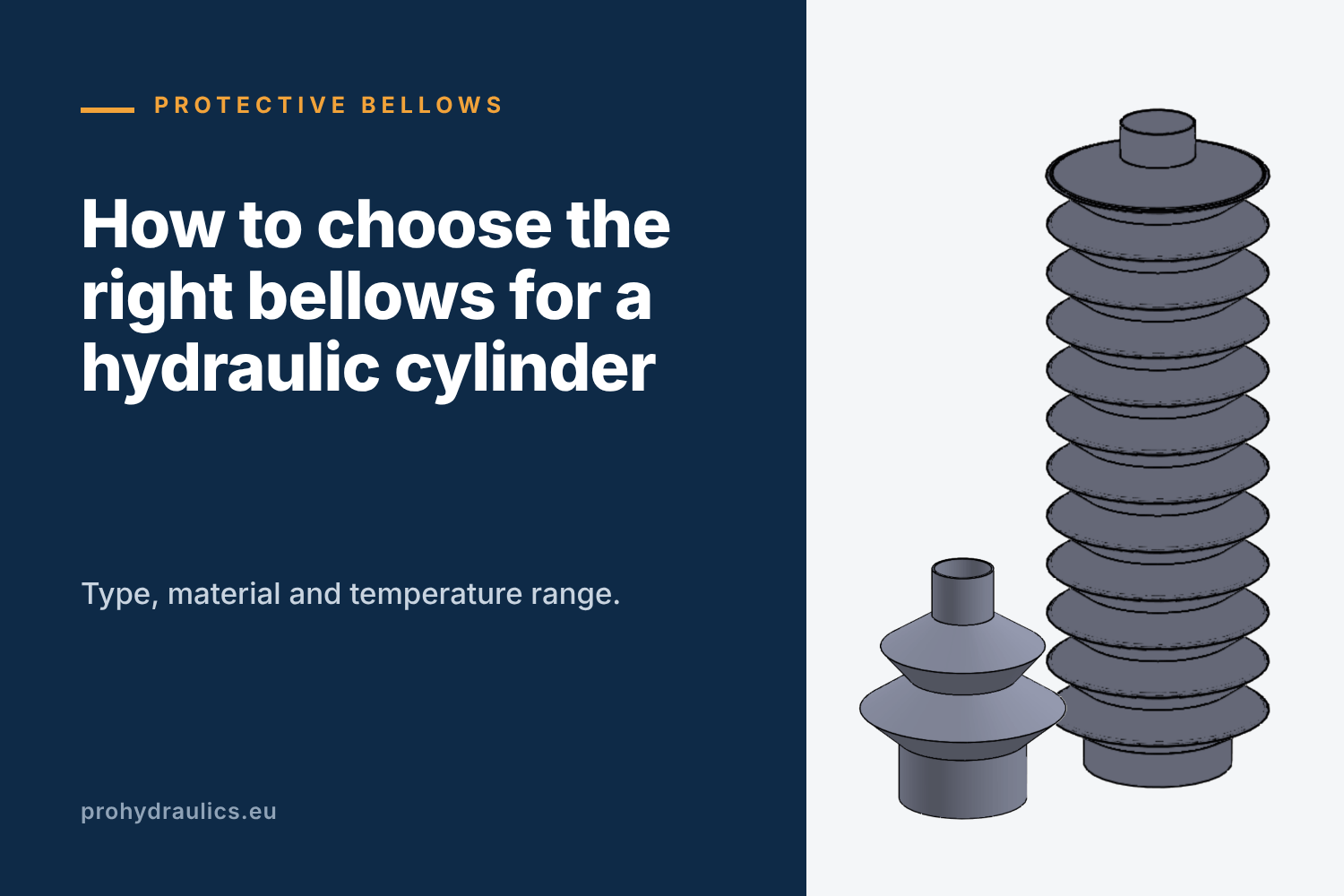
A protective bellows keeps dust, dirt and abrasive particles away from the moving parts of a cylinder, which extends machine life, cuts downtime and makes the machine safer to operate. The right choice depends on four things: temperature, the surrounding medium, how the cylinder moves and how the bellows can be fitted.
We receive inquiries for protective bellows from steel and metallurgy, cement, shipbuilding and marine logistics, oil and gas, hydropower, chemical and petrochemical industry and machine building. The same questions come up in every one of these industries, so we have put the answers in one place.
Why a cylinder rod needs protection
A hydraulic or pneumatic cylinder rod works in the open. Abrasive dust, process particles and moisture settle on it, are dragged under the seal on the return stroke and wear the seal and the rod surface. A bellows closes this path and keeps the rod surface and the seal clean.
Types of protective bellows
- Cylindrical fold bellows: Molerit® (TPE), -40 °C to +90 °C. The most widely used type, weather-resistant, with good chemical resistance.
- Conical fold bellows: chloroprene (CR), -30 °C to +100 °C. Resistant to acids and solvents, suitable for demanding environments.
- Single-fold (disc) bellows: CSM, -30 °C to +120 °C. Takes minimal space when compressed, for components that retract completely.
- Rod Protection Cover™: fabric with Velcro or strap closure, -30 °C to +120 °C. A sewn cover that is fitted without taking the cylinder apart.
- Box bellows and way covers: fabric or rubber, up to +200 °C. For scissor lifts and machine guideways, with protection on all sides.
- Moulded rubber bellows: NBR, CR or other compounds, up to +150 °C. Custom shape for larger, regularly repeated volumes.
- PTFE turned bellows: PTFE, -60 °C to +200 °C. Maximum chemical resistance, food-grade where required.
- Kevlar-reinforced bellows: Kevlar and rubber composite, up to +600 °C. High abrasion and cut resistance, extreme heat.
How to choose: four questions
- What is the working temperature? Up to +90 °C a Molerit® fold bellows is usually enough. Between +100 °C and +200 °C look at CSM, fabric or rubber, or PTFE. Up to +600 °C only the Kevlar composite applies.
- What is around the cylinder? Acids and solvents point to chloroprene. Oils and chemicals together with outdoor weather point to CSM. Aggressive media of almost any kind point to PTFE.
- How does the cylinder move? If the protected part retracts completely and space is short, a single-fold bellows saves length. For a long stroke a fold bellows is the normal choice.
- Can the cylinder be taken apart? If not, a Rod Protection Cover with a longitudinal Velcro or strap closure is fitted on the rod without dismantling anything.
Mechanical load adds a fifth point. Where the bellows meets sharp particles or heavy abrasion, a fabric or Kevlar-reinforced design lasts longer than a plain rubber one.
Standard sizes and custom bellows
Standard and custom dimensions are both available. Recent inquiries ranged from compact bellows around Ø14 mm to large ones around Ø90 mm, and the material and shape can be matched to the operating conditions. Where the machine has no standard size, a bellows can also be designed as a functional part of the machine itself.
What to send for a quotation
For an offer we need only a few facts:
- a drawing or a sketch, or a photo of the existing bellows or the cylinder
- rod diameter and stroke, with the compressed and extended length of the bellows
- working temperature and the medium around the cylinder
- how the bellows is fitted, and whether the cylinder can be taken apart
- the quantity, one-off or regular
If the drawing is not ready, send the technical requirements. We select the type, material and configuration for the application.
Contact
Send the request to office@prohydraulics.eu or through prohydraulics.eu.